 AI-First
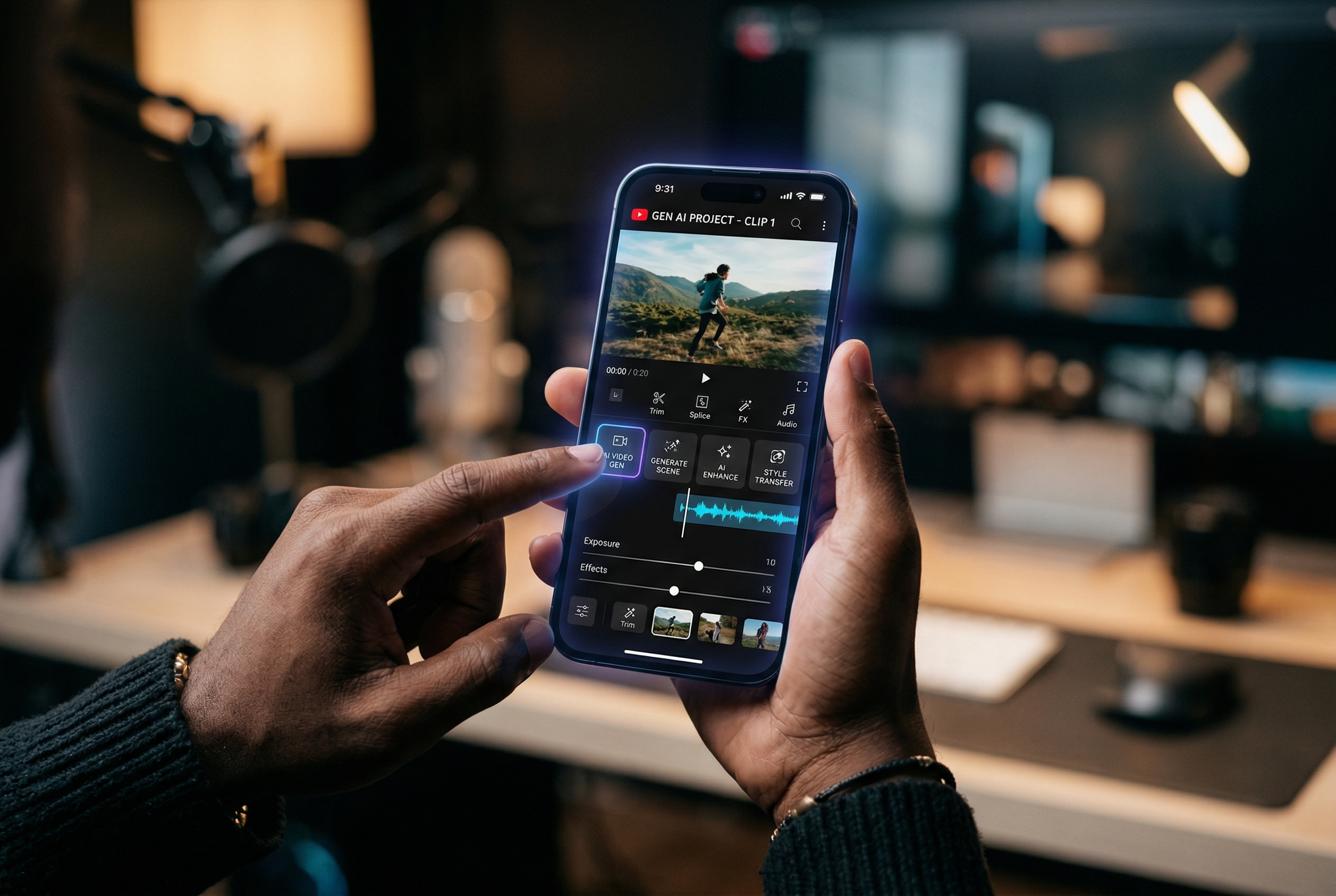
- 🔑 YouTube integrates AI video generation on mobile, turning an idea into a short without complex editing.
- 🎯 The real shift isn't the wow factor but the speed of production and iteration on shorts.
- 💡 Start with a one-sentence promise, a single visual scene, a format readable in three seconds.
- ⚠️ AI doesn't replace the concept, it replaces the friction that kills shorts before they exist.
- 🚀 Producing ten variations in ten minutes transforms the learning capacity of early-moving creators.
YouTube Just Added AI Video Generation. And It's Far More Powerful Than You Think.
From mobile, YouTube is starting to turn an idea into a short video without complex editing.
The real change isn't the wow factor, it's the speed of content production.
Creators who test early will learn the system before everyone else.
Traditional editing is no longer the only path to a decent short video.
What this feature actually changes
The update doesn't just say 'you can generate a video.' What it really says is that mobile creation is becoming an AI-assisted workflow, closer to instant than to post-production. For a creator, that means testing more ideas, publishing faster, and iterating without going through a heavy editing pipeline.
The key point: AI doesn't replace the concept. It replaces the friction. And friction is often what kills shorts before they even exist.
How to use it without producing empty content
If you're testing this kind of tool, start with a simple idea, a clear angle, and a specific goal. You don't need an abstract prompt. Give it a topic, a visual gesture, and an intention. The AI will handle the rest, but it will do better if you already know what the video should trigger.
A promise in one sentence
A single visual scene
A short format, readable in 3 seconds
A testing objective, not just a demo
The real advantage: the learning loop
The most interesting AI tools aren't the ones making the most noise. They're the ones that shrink the gap between idea, test, and feedback. For shorts, that loop is everything. If you can produce three variations in ten minutes instead of one in an hour, you fundamentally change your learning capacity.
| Approach | Time | Result |
|---|---|---|
Traditional editing | Long | Fewer iterations |
Mobile AI generation | Short | More tests |
The win isn't making one video. The win is making ten before the first wave of fatigue hits.
Conclusion
YouTube isn't just launching a feature. It's normalizing a new habit: creating faster, straight from your phone, with AI as the production layer. For creators, the question is no longer 'does it work?' but 'who will learn fastest?'
And in that game, being early matters more than having the perfect output.