 AI-First
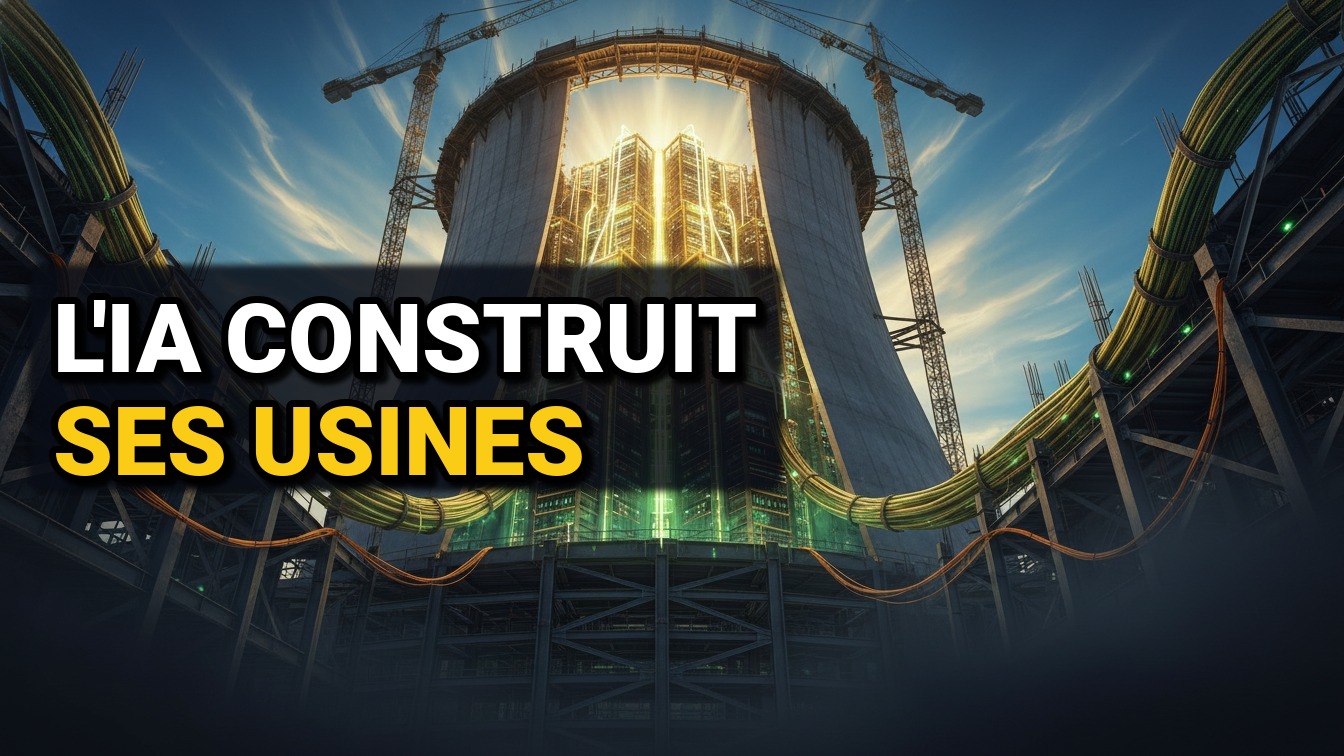
AI data center construction surpassed $227 billion in 2025, according to Global Market Insights, driven by hyperscale projects that mobilize thousands of workers and demand gigawatts of power. These buildings are the physical backbone of every piece of artificial intelligence you use daily: every Claude query, every generated image, every automation I deploy for my SMB clients runs on servers housed in industrial halls that consume as much electricity as a mid-sized city. And the construction race has reached a pace no one anticipated.
- 📊 $227 billion in 2025: the global data center construction market is exploding.
- ⚡ Energy under strain: a single Stargate site draws 1.2 GW, enough to power one million homes.
- 🏗️ Massive job sites: 5,000 to 8,000 workers per site, 480,000 m³ of concrete poured at Abilene.
- 🌍 Heavy local impact: polluted water, gridlocked roads, overruled votes, communities paying the price.
The global data center construction market reached $227.6 billion in 2025, according to Global Market Insights. Projections point to $434.7 billion by 2035, a compound annual growth rate of 6.8%. I find these figures both fascinating and troubling. Here is why this frenzy of concrete and steel deserves the attention of every business leader using AI.
What is actually being built (and at what scale)
A hyperscale data center construction site now mobilizes between 5,000 and 8,000 workers on the ground, at an average cost of $475 million per project according to ConstructConnect (June 2026), up from $178 million the previous year. The scale of these builds has no equivalent in contemporary civil construction.
The Stargate project, announced in January 2025 in Abilene, Texas, illustrates the sheer magnitude. This city of 133,000 residents is now home to the largest active construction site in the United States.
How many people work on a giant data center build?
The numbers reported on-site are staggering. More than 5,000 workers are active simultaneously at the Abilene site, with projections climbing to 8,000 at peak activity. The build has already consumed over 7.5 million labor hours, with another year of construction ahead. Ten buildings are underway, and the master plan calls for twenty.
To put that in perspective: 480,000 m³ of concrete have been poured on site, the equivalent of 6,100 single-family home foundations. When a site manager draws that comparison on BigCountryHomepage, you realize this is no longer just a data center; it is a small industrial city.
The initial commitment from Oracle and OpenAI was for a facility capable of absorbing 1.2 gigawatts of power. An additional 700 megawatts had been considered before being dropped. Microsoft stepped in as the new partner on the Abilene site.
Why is phased construction the norm?
Phased construction is standard practice in the data center industry, as Laminar Projects explains. The principle is straightforward: you only deploy the infrastructure needed for the first tenants. Upper floors, additional generators, extra cooling systems, all of that waits.
The reason is financial. Generators, transformers, and chillers account for a significant share of the total cost. Deferring that investment lets developers preserve cash flow and launch other projects in parallel. It is exactly the logic I recommend to my clients when they want to integrate AI into their business: start small, validate the return, then scale up.
Energy: the bottleneck nobody is solving
At its most basic, a data center is a machine that converts electrical energy into computing power. And that is precisely where the problem lies.
Where does the electricity come from to power these facilities?
The question keeps coming up in the field. Technicians at Abilene put it bluntly: when a data center moves into an area, it requests a grid connection within 18 to 24 months. The power grid, however, operates on 3-to-5-year planning cycles. The mismatch is structural.
Jensen Huang, Nvidia's CEO, has publicly stated that building a data center takes about 3 years in the United States. He contrasts that pace with China, "which can build a hospital in a weekend." On r/technology, a highly upvoted comment (2,303 points) sets the record straight: "Most of the time isn't in construction itself, it's in grid-access permits and component supply constraints."
Another user, who spent a year in a building erected in six months in northeastern China, recounts water seeping through concrete walls and mold covering surfaces within months. Building fast does not mean building well, especially for facilities meant to run around the clock for decades.
| Metric | Abilene (Stargate) | Dartford (Custodian DA2) | France (overall market) | Trend |
|---|---|---|---|---|
| Power capacity | 1.2 GW | 10 MW | ~1 GW cumulative | ↑ +58% projected |
| Rack count | Not disclosed | 800 | ~50,000 (existing fleet) | ↑ strong growth |
| Footprint | Several km² | 2,500 m² | Expanding | ↑ new campuses |
| Target PUE | Not disclosed | Ultra-free cooling | < 1.4 (EU standards) | ↓ regulatory pressure |
| Key players | Oracle, Microsoft | Custodian | Bouygues, Eiffage, Vinci | → consolidation |
SOURCE: cited transcripts + Mordor Intelligence · Updated 05/2026
In France, the major players are Bouygues Construction, Eiffage, Vinci Energies, Equans, and Cap Ingelec, according to Mordor Intelligence.
When local communities say no (and construction goes ahead anyway)
Across the United States, communities are undergoing radical transformations they never chose: gridlocked roads, polluted water, overruled votes. Documented cases since 2024 reveal a recurring pattern: local refusal, legal action by developers, construction starting regardless.
The hidden side of this construction frenzy is its impact on local populations. And the testimony I have compiled speaks for itself.
How does a data center change life in a small town?
In Abilene, residents describe a brutal transformation. Robert, a local living 1.5 miles from the Stargate site, says his commute went from 10 to 40 minutes. The roads were never designed for the volume of trucks and heavy equipment. Operations run around the clock, with a constant flow of workers.
The Michigan case is even more striking. In September 2025, Saline Township voted unanimously against the $16 billion OpenAI-Oracle Stargate data center. Two days later, the developer, Related Digital, sued the township for "exclusionary zoning" and secured a settlement within weeks. Construction began in early 2026 and is currently underway (status: IN PROGRESS, June 2026). On r/technology, the post garnered 18,770 upvotes. One user noted with irony: "The township got about $14 million in community benefits. 0.1% of the deal, for something they had voted down."
What is the impact on water and the environment?
In Georgia, Representative AOC showed Congress what residents' drinking water looked like after a Meta data center broke ground. The post on r/PoursTea generated nearly 8,000 upvotes. One comment summed up the tension: "You can live without data centers. You can't live without clean water."
I am not anti-data center. But the Sanders-AOC bill introduced on March 25, 2026 in Congress (a moratorium on any new data center exceeding 20 MW until a federal regulatory framework is adopted) raises a legitimate question about the pace of this expansion. Status: under review, with slim chances of passing given the Republican majority.
What this means for SMBs using AI
Every SMB leader using cloud services or AI depends indirectly on this construction race. And the implications are concrete.
Should you worry about AI service availability?
The shortage of compute infrastructure is real. When Anthropic signs a deal in May 2026 worth $1.25 billion per month to lease Colossus 1 (the xAI datacenter, Elon Musk's AI subsidiary in Memphis, Tennessee, not to be confused with Colossus 2, the expanding site in Southaven, Mississippi), as I analyzed in this article on the Claude x Colossus deal, it is precisely because compute demand outstrips existing supply.
For an SMB, this means three things. API and cloud service prices will not drop until supply catches up with demand. Response times may fluctuate depending on data center load. And geographic concentration (primarily Texas, Virginia, and a few European hubs) creates latency risks for French businesses looking to deploy high-performance software solutions.
Why is phased construction good news?
The phased construction approach that Custodian Data Centres applies at its DA2 site in Dartford (800 racks, 10 MW of power, free cooling) is reassuring. It signals that the industry is not acting recklessly: it sizes investments based on actual demand, not optimistic projections.
It is exactly the same logic I push with my clients. Do not deploy a full AI system before validating a first use case. The parallel with data center construction is striking: the best developers build one floor first, install the first tenants, then expand. Companies that succeed at AI automation do the same.
"A data center solves nothing if there is no concrete use case behind every installed rack. Phased construction understands this. SMBs should apply the same discipline to their AI projects."
Vincent, May 2026
The real issue is not concrete, it is integration
The $227 billion poured into data center construction in 2025 guarantees one thing: the computing power to run AI will exist. It will exist at massive scale. The real issue for a French SMB is not how many megawatts the Stargate project consumes.
The real issue is what you do with the computing power already available. I have worked with enough companies to see that most do not use even 5% of the AI capabilities accessible today. While billions flow into Texas concrete, your manual processes still cost just as much.
My advice: do not worry about data center construction. Worry about mapping your automatable tasks. The infrastructure is coming; it is already on its way. It is the integration into your workflows that will make the difference, not the number of racks installed somewhere in Texas.
Frequently asked questions
How much does it cost to build a data center in 2026?
A hyperscale data center like Stargate in Abilene exceeds $500 million per building. For a regional facility in France, expect 20 to 100 million euros depending on the target certification (Tier III or IV). The global market reaches $241 billion in 2026 according to Global Market Insights.
Why do data centers consume so much energy?
Cooling accounts for 30 to 40% of a data center's total power consumption. AI workloads require far higher power density than standard cloud workloads. A single Stargate site consumes 1.2 GW, the equivalent of one million American households.
Do AI data centers threaten local resources?
Documented cases in the United States show real impacts: degraded drinking water in Georgia (Meta), gridlocked roads in Abilene (Stargate). In Europe, the Energy Efficiency Directive mandates a PUE below 1.4 for new data centers since 2025. French contractors incorporate BREEAM and LEED certifications.
How can a French SMB prepare for the impact of this construction boom?
The massive construction of data centers will eventually drive down AI computing costs. For an SMB, the priority is not to monitor building sites, but to prepare AI use cases now. Identify your repetitive, high-cost tasks, test an initial automated workflow, then scale up gradually. By the time this infrastructure is fully operational (2027 to 2028 for current major projects), your business will be ready to leverage significantly cheaper computing power.
Is France also building data centers at scale?
Yes. France's leading constructors are Bouygues Construction, Eiffage, Vinci Energies, and Equans, according to Mordor Intelligence. OVHcloud, Data4 Group, Interxion (Digital Realty), and Euclyde Data Centers are among the most active operators. France positions itself as a European hub thanks to its low-carbon nuclear energy, a real competitive advantage in a context where PUE and carbon footprint are becoming selection criteria for cloud customers.
Vidéos YouTube
- Inside the city where OpenAI is building its largest data center · Soon
- Abilene's Data Center advances swiftly with 5,000+ workers · BigCountryHomepage
- Phased construction in data centers · Laminar Projects
- HOW TO BUILD A DATA CENTRE - Introduction - Episode 1 · Custodian Data Centres
Discussions Reddit
- Nvidia CEO says data centers take about 3 years to construct · r/technology
- Would you support a law to stop the construction of new AI data centers? · r/antiai
- A Michigan farm town voted down plans for a giant OpenAI-Oracle data center · r/technology
- Michigan residents voted down a $16 billion Stargate AI data center · r/technology
- AOC: This is what drinking water in Georgia looks like after Meta began data center construction · r/PoursTea
Articles & ressources
- Data center construction market size and share 2026 · gminsights.com
- Complete guide to building a high-performance data center · mission-open-data.fr
- Data center design and construction: the complete guide · avigilon.com
- Data center turnkey design-build · groupeidec.com
- Data center construction in France: companies · mordorintelligence.com